Picking a program you’re most comfortable with
The tactic behind picking an audio program that you’re comfortable with to make music doesn’t have to be complicated.
There’s just a few specific parts that you have to get a natural feel for when it comes to recording your sound.
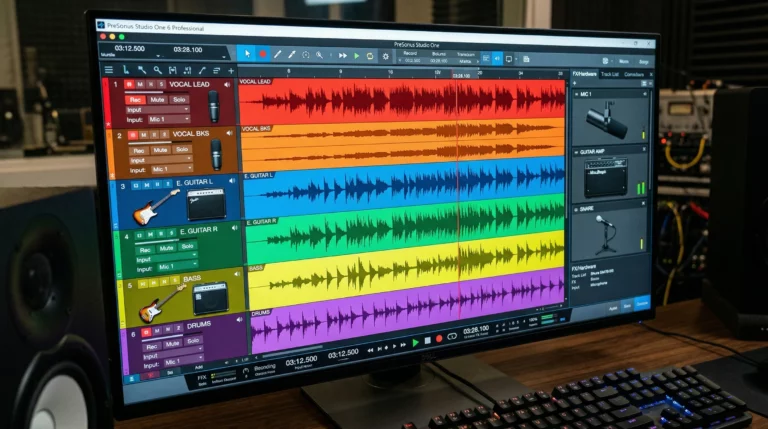
And when you choose a program that can do such a thing, you’re going to look for ones that allow you to arrange the, Layers that you’re going to be recording on and mixing ultimately.
This will look like where after you record your vocals, you’re going to also be able to move your layer track around and have it mesh best with the beat as you can appreciate with your own ears.
And ultimately the listeners that will be listening to your sound as well too.
You’re not going to want to start off with something that’s overly complicated and too many different buttons and knobs that’s able to be manipulated, which you don’t understand already yet.
This is assuming that you are pretty new to the recording process.
And you can actually turn your idea into a rough draft into these programs pretty quickly once you get familiar with them.
Because you can get to where you might want to catch the beat at a certain time, but have it, come in a lot earlier than when you started.
This is where having the right program is going to be crucial to that step.
Because you’re going to want things that will allow you to completely pick up your track, move it around, splice different sections if necessary.
And do things along the lines of adding gain or reducing it if necessary too.
This, Daw set up, is, Most applicable with rapping, if you’re going to get on hip hop beats that have different measures. that you are experimenting with.
There might be different drops that you’re looking to.
Align your actual vocals with, and this is where having your ideal setup is important because you might hear something differently than how it sounds. to start things off with.
And that’s where you’re not going to feel overwhelmed or too nervous to actually record yourself because you’re not worried about making sure that you get your take done at the specific point where you would hear your final product.
The learning curve that you’re realistically committing to is just recording your voice and having it catch at the points that will allow you to continue rapping.
This is something that might sound simple in nature, but it’s a real obstacle for many people that want to rap, but they feel they’re not wrapping on beat or able to have a sound that is comparable to anybody else that does it professionally.
Look to pick something that allows you to manipulate the vocals
Picking something that allows you to manipulate the vocals you place your recordings in is yet another crucial step in selecting your audio interface.
I jumped around several different programs, before I got comfortable just recently with ironically the first audio tool I got introduced to— GarageBand.
That’s not to say that the other programs I created on weren’t useful, matter fact, I sometimes will bounce around to Spire too.
What those 2 programs have in common that they allow me to do is adjust the loudness of my voice and the beat as well.
That’s a highly important feature for me since I value being heard clearly when my vocals get mixed in with a beat.
Have your program be able to move the sounds around
Having your program have the ability to move your audio around is an absolute non-negotiable.
I’m not even sure if there’s programs in 2026 that are being made like this, or what DAW systems don’t have this capability, but we’re building this from the ground up, and that includes addressing the obvious.
Moving the sounds around is a must because it adds an organizing element to your operation.
You’re likely going to be working with several sounds when you get to where you’re making more sophisticated sounds, and being able to move them around includes muting them if necessary, layering files to be on top of others, sometimes in particular orders for a desired effect.
Get an area that confines the sound that bounces around
Getting an area that confines the sounds you’re going to be making is another important step.
This is getting more into the technical aspects of music making, but it’s needed to keep this in mind.
I find that my programs I work with have different quality ranges depending on where I’m recording from.
It’s likely a consistency issue that would need to be addressed if you’re having problems in this area, although recording on the move is starting to turn into a new standard.
I have the luxury of recording in a room that’s as tall as I am with a wooded interior.
That’s something I’m sure has had a major impact on the quality of my sound ultimately.